
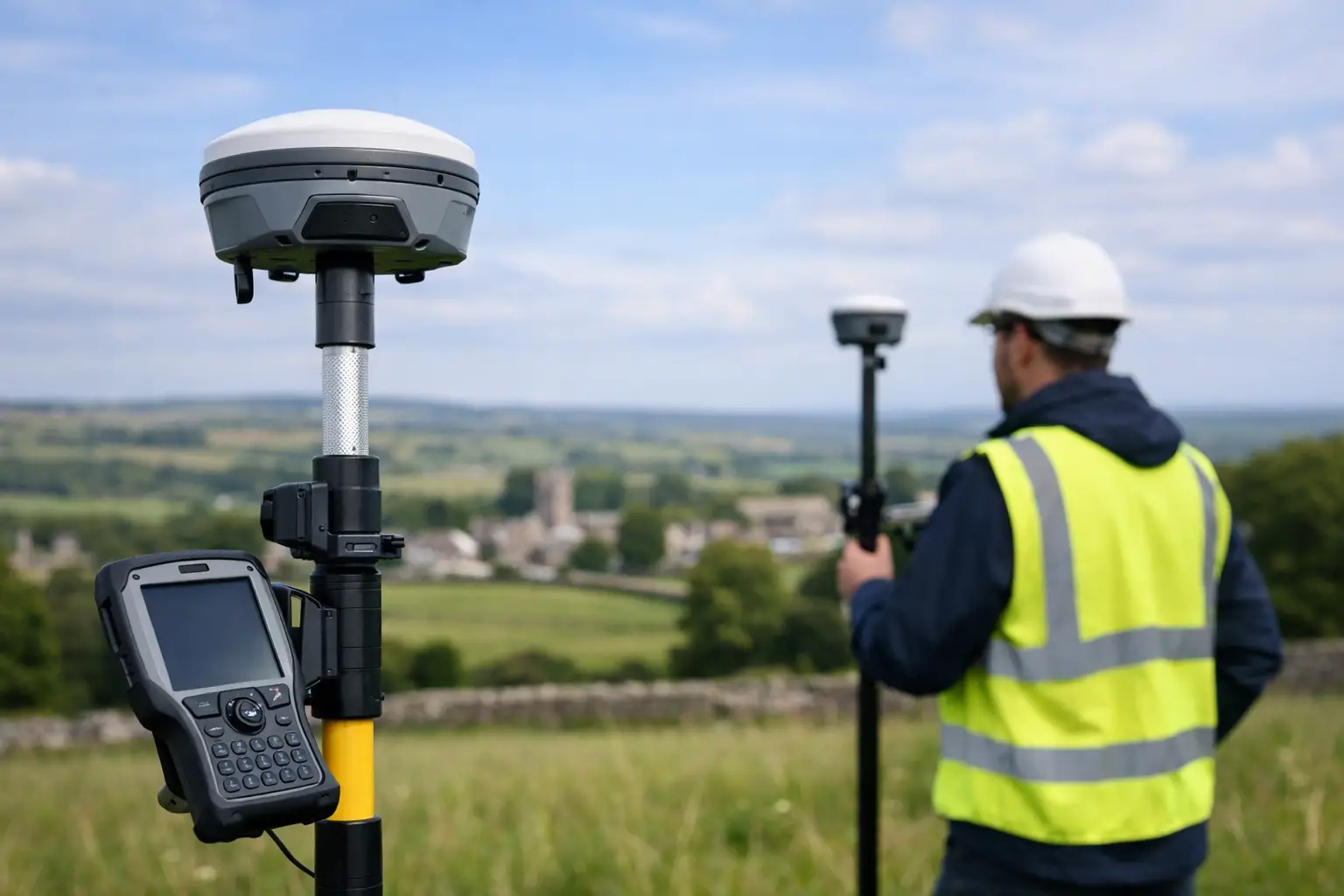
If you are comparing systems right now, an rtk rover buying guide should do more than repeat headline specs. The real question is whether a rover will hold accuracy on your sites, fit your workflow, and keep productive crews moving without adding avoidable support issues. For UK survey, construction and asset teams, the right choice is usually the one that balances correction reliability, field usability and downstream data compatibility.
What this RTK rover buying guide should help you decide
A professional RTK rover is not simply a box that delivers centimetre-level coordinates. It is part of an operational chain that includes GNSS tracking, correction delivery, field software, data export, training and after-sales support. If one part of that chain is weak, the whole investment underperforms.
That is why buying on price alone often creates expensive friction later. A lower-cost rover may look competitive on a specification sheet, but if it struggles under tree cover, lacks a stable correction workflow, or produces awkward exports for your office team, the savings disappear quickly. Commercial buyers should assess the full working system, not just the hardware.
Start with the job, not the brochure
Before comparing models, define the type of work the rover needs to handle most often. Setting out on open construction sites is different from topographic survey near buildings, utilities work in constrained environments, or mapping linear infrastructure where crews need to cover ground quickly.
If your sites are generally open with good mobile coverage, many modern RTK rovers will perform well enough. If your teams work near woodland, embankments, dense urban features or intermittent signal conditions, the tolerance for weak performance drops sharply. In those cases, receiver quality, multi-constellation tracking and correction resilience matter far more than headline marketing claims.
It also helps to be honest about who will use the equipment. A surveyor with strong GNSS experience can work around limitations that may slow down a broader site team. If the rover will be used by engineers, setting-out operatives or utility crews, simple field workflows and reliable fixed solutions are often more valuable than advanced functions that rarely leave the menu.
Accuracy claims need context
Every rover promises high accuracy, but professional buyers should look closely at how that accuracy is achieved and under what conditions. A quoted horizontal and vertical accuracy figure is only part of the picture. The more useful question is how quickly the rover reaches a fixed solution and how consistently it maintains it during normal field use.
This is where receiver engine quality and satellite tracking become significant. Strong support for GPS, GLONASS, Galileo and BeiDou gives the rover more observations to work with, which can improve reliability in more difficult environments. Tilt compensation can also be valuable, particularly for fast topographic work or points near walls, fences and inaccessible features. Even so, tilt should support good surveying practice, not replace it. Buyers should confirm how tilt affects achievable accuracy and whether it suits their required tolerances.
For many professional applications, repeatability matters as much as absolute claimed precision. A rover that delivers stable, repeatable coordinates through a full working day is usually more commercially useful than one that looks exceptional in ideal test conditions but becomes inconsistent on real sites.
Correction services will shape day-to-day performance
An RTK rover is only as effective as the correction source behind it. In the UK, that often means working through NTRIP over mobile data, either via a national network, a regional service or a private correction setup. This part of the buying decision is frequently underestimated.
You need to consider signal availability across your operating area, not just at head office or on one familiar site. Rural jobs, transport corridors and remote utility routes may have weaker mobile data coverage, which can interrupt correction delivery. If your crews regularly work in those environments, ask how the rover behaves during dropouts, how quickly it re-establishes a fix, and whether alternative workflows are practical.
There is also a commercial decision here. A lower upfront hardware cost can be offset by ongoing subscription fees if the correction model is not right for your business. For some organisations, a bundled support and corrections approach is easier to manage. For others, flexibility across multiple services is more valuable.
Field software often decides whether crews actually like using it
A capable receiver can still become a poor purchase if the field software slows work down. In practice, your team will spend more time interacting with the controller and data collection app than thinking about the GNSS board inside the pole.
Look closely at how the system handles common tasks such as coding points, setting out lines, checking tolerances, managing coordinate systems and exporting results. The best workflows are clear, fast and difficult to get wrong under site pressure. That matters in construction and engineering environments where time on site is expensive and mistakes can ripple into rework.
Compatibility with your office environment is just as important. If you need outputs for CAD, GIS, machine control or asset management systems, confirm the format and process before purchase. A rover that captures good data but creates delays in handover is not efficient. This is one reason many buyers prefer to work with a supplier that understands the complete workflow rather than just dispatching hardware.
Build quality and ergonomics matter more than they seem
Professional rovers are field tools, so durability should not be treated as a minor detail. Weather resistance, battery performance, pole mounting security and controller robustness all affect productivity. A unit that needs frequent charging, loses connection between devices, or feels awkward over a full shift can become frustrating very quickly.
Weight and handling also matter. If crews are carrying the system all day across mixed terrain, small differences in ergonomics can improve fatigue and speed. That is particularly relevant for topographic surveys, utilities tracing and long linear jobs where productivity is driven by steady point capture rather than occasional measurements.
For organisations buying multiple units, standardisation can be a hidden advantage. Consistent hardware, batteries, accessories and setup processes reduce training time and simplify support.
The real cost is ownership, not purchase price
A practical rtk rover buying guide has to address total cost of ownership. The purchase price is only one part of the investment. You should also account for correction subscriptions, field software licences, training, support, servicing, replacement accessories and the internal cost of downtime.
This is where the cheapest option can become the most expensive. If a failed controller stops a crew for a day, or if poor support leaves your team troubleshooting on site, the cost is immediate. For contractors and service providers, that impact is not theoretical. It affects programme delivery, client confidence and margin.
Support quality is therefore a buying criterion, not an afterthought. Ask who provides setup assistance, firmware updates, troubleshooting and user training. Confirm whether support is UK-based and whether the supplier understands real survey and construction workflows. Buyers who need dependable outcomes usually benefit from working with a specialist partner rather than a general reseller.
Questions worth asking before you buy
The strongest buying decisions usually come from a live discussion or demonstration, not a static specification sheet. Ask how the rover performs near buildings and under partial canopy. Ask what correction options are recommended for your operating area. Ask how data moves from field to office. Ask what happens if a unit fails mid-project.
It is also sensible to request a demonstration built around your use case. A construction firm may need efficient setting out with clear tolerance checks. A utilities team may prioritise fast topo capture and reliable fixes in constrained streets. A survey practice may care more about coordinate system control, repeatability and export flexibility. The right system depends on the work.
For organisations looking at a wider geospatial workflow, there can be value in choosing a supplier that also understands LiDAR, drones, processing and outsourced field support. LiDAR Tech UK operates in that wider environment, which can be useful where RTK positioning needs to integrate with broader spatial data capture and delivery.
Buy for reliability on your sites
There is no single best rover for every buyer. Some organisations need a straightforward, cost-effective setup for regular site work in open conditions. Others need a more capable system that holds performance in difficult environments and integrates cleanly with demanding survey workflows.
The better question is not which rover has the longest feature list. It is which one will give your team reliable fixed solutions, efficient field operation and dependable support over the next several years. If a system can do that, it is far more likely to deliver a sound return than one chosen purely on headline price or marketing language.
A good purchase is the one that still feels right after a wet week on site, a tight programme, and a client who expects answers first time.