
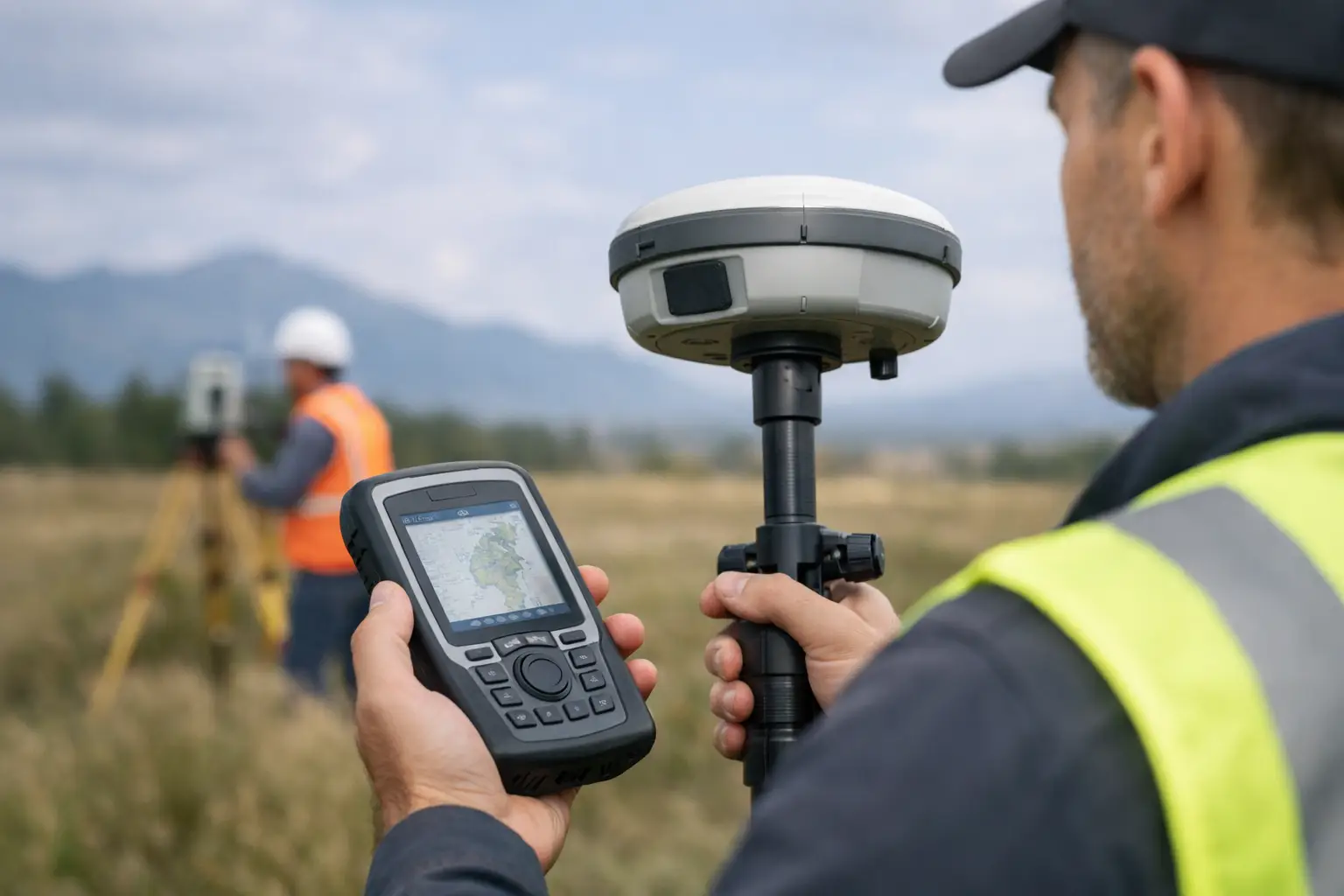
A missed fix on a live site does more than slow the job down. It can delay setting out, force return visits and create doubt in the data. That is why choosing the right GNSS receiver for surveyors is not simply a hardware decision. It is an operational decision that affects productivity, confidence and the quality of every downstream deliverable.
For professional users, the real question is not which unit has the longest specification sheet. It is which system gives dependable results in the environments you actually work in, with workflows your team can adopt quickly, and support that keeps projects moving when conditions are less than ideal.
What surveyors should expect from a GNSS receiver
A professional GNSS receiver should provide more than a position. It should deliver repeatable, verifiable accuracy under practical site conditions, whether that means open rural land, urban streets with partial sky obstruction or active construction environments with tight deadlines.
At minimum, surveyors will expect multi-constellation tracking, stable RTK performance, fast initialisation and reliable communications for receiving corrections. Beyond that, the better systems reduce friction in daily use. That includes intuitive field software, efficient stakeout tools, straightforward coordinate system management and dependable battery life across a full working day.
This is where specification and usability need to be considered together. A receiver may look strong on paper, but if the controller software is awkward, the radio link is inconsistent or the setup process slows down less experienced operators, the claimed performance becomes less valuable in practice.
How to assess a GNSS receiver for surveyors
The right buying criteria depend on your workload. A surveying practice focused on topographic surveys will not necessarily prioritise the same features as a civil engineering contractor carrying out setting out and machine control support. Still, a few core areas matter almost every time.
Accuracy and fix reliability
Manufacturers often quote horizontal and vertical accuracy under ideal RTK conditions. Those figures are useful, but they are not the whole story. What matters just as much is how consistently the receiver holds a fixed solution when visibility is compromised by buildings, trees or site structures.
For many buyers, the practical distinction is between occasional performance and dependable performance. A receiver that achieves excellent results on an open test field but struggles around partial obstructions may not be the best commercial choice if your work regularly involves infrastructure corridors, utility assets or built-up sites.
Correction services and connectivity
Most professional operations rely on RTK corrections through NTRIP, local base stations or a wider correction network. The GNSS receiver needs to fit that correction method without introducing complexity for the field team.
If your crews are working across different parts of the UK, mobile data reliability matters. Dual SIM capability, strong modem performance and straightforward network configuration can make a noticeable difference. If your workflow depends on local base and rover setups, then radio performance and ease of configuration become more important.
Field software and data flow
A receiver is only one part of the system. Surveyors should look closely at how observations are collected, coded, checked and exported. Poor software can create bottlenecks long after the fieldwork is complete.
Good field software should support common survey tasks efficiently, including topo survey, stakeout, control checks and point coding. It should also integrate cleanly with your office environment so that CAD-ready or processing-ready outputs do not require unnecessary manual intervention.
Build quality and field practicality
Survey equipment is used in rain, dust, mud and traffic management environments. A compact and well-balanced rover may reduce operator fatigue on longer days, while ingress protection, pole stability and battery endurance all contribute to actual site performance.
Surveyors should also consider startup time, screen readability on the controller and how easy the system is to troubleshoot in the field. Small practical details often have a larger effect on productivity than headline specifications.
Matching the receiver to the job
The best GNSS receiver for surveyors depends heavily on application. There is no single correct model for every buyer, because different sectors place different demands on accuracy, speed and resilience.
For topographic and measured surveys, consistency and clean data capture usually matter more than extreme complexity. Surveyors need reliable RTK, efficient coding and straightforward export into existing CAD or GIS workflows.
For construction and setting out, the priority often shifts towards speed, confidence and repeatability. Crews need to move quickly between points, verify positions without delay and maintain accuracy in environments where partial obstructions are common.
Utilities and infrastructure teams may place more emphasis on reliability in difficult signal conditions and on workflows that support asset capture over wide areas. Forestry and rural land users may value strong satellite tracking in mixed environments and long battery life for extended field sessions.
This is why product selection works best when linked to the actual project mix rather than broad marketing claims. A receiver that is right for one business may be a poor fit for another with different site constraints and reporting requirements.
Beyond the rover head – the full system matters
Many purchasing decisions focus too narrowly on the GNSS unit itself. In practice, professional results depend on the full system: receiver, controller, software, corrections, accessories, training and support.
If a business is adopting new equipment across multiple crews, implementation becomes especially important. Even capable surveyors can lose time if setup, coordinate systems or data handling are not standardised from the outset. The value of supplier support increases further when teams are under programme pressure and cannot afford avoidable downtime.
This is one area where working with a specialist provider can make a measurable difference. The equipment matters, but so does pre-sales advice, onboarding, technical assistance and the ability to align the system with your existing geospatial workflows.
Common trade-offs buyers should recognise
There is usually a balance between cost, capability and operational simplicity. A lower entry price can look attractive, but if fix reliability is weaker or software productivity is poor, the total cost over time may be higher through rework, delays and lost field hours.
Equally, the most feature-rich system is not automatically the best option. Some organisations do not need advanced functions that add cost and complexity without improving daily output. The right investment level depends on survey volume, required accuracy, operator skill and the commercial value of faster completion.
Another common trade-off is between standalone hardware purchase and a more complete solution. Some buyers only want the unit. Others benefit more from a package that includes setup, training, correction services and ongoing support. For teams expanding capability or replacing older workflows, the second approach often reduces risk.
Questions worth asking before you buy
Before committing to any GNSS system, it is worth testing it against your real operating conditions. Ask how it performs near buildings, under tree cover or around plant and steelwork. Check how quickly a new operator can become productive. Review the software workflow from field capture through to office output. Confirm what support is available if there is an issue during a live project.
It is also sensible to ask about firmware updates, service arrangements and how easily the receiver can fit alongside other technologies such as total stations, UAV mapping outputs or LiDAR datasets. For many organisations, the receiver is part of a wider spatial data ecosystem rather than a standalone tool.
LiDAR Tech UK works with professional users who need that broader view, where GNSS performance is judged not only by satellite tracking but by how effectively it supports surveying, mapping and data capture at project level.
Why the right choice pays back quickly
A well-matched GNSS receiver improves more than point collection speed. It reduces revisits, strengthens confidence in setting out, shortens training time for new operators and helps maintain quality across multiple crews. Those gains have direct commercial value, especially where project margins depend on efficient field delivery.
For businesses tendering for more demanding work, reliable GNSS capability also supports a stronger service offer. Accurate, repeatable positioning underpins faster surveys, cleaner outputs and better integration with photogrammetry, mobile mapping and LiDAR-led workflows.
The strongest buying decisions are usually the least complicated. Choose the system that gives your team dependable accuracy, practical field efficiency and support you can rely on when deadlines are tight. If the receiver fits the work, the rest of the workflow becomes easier to trust.