
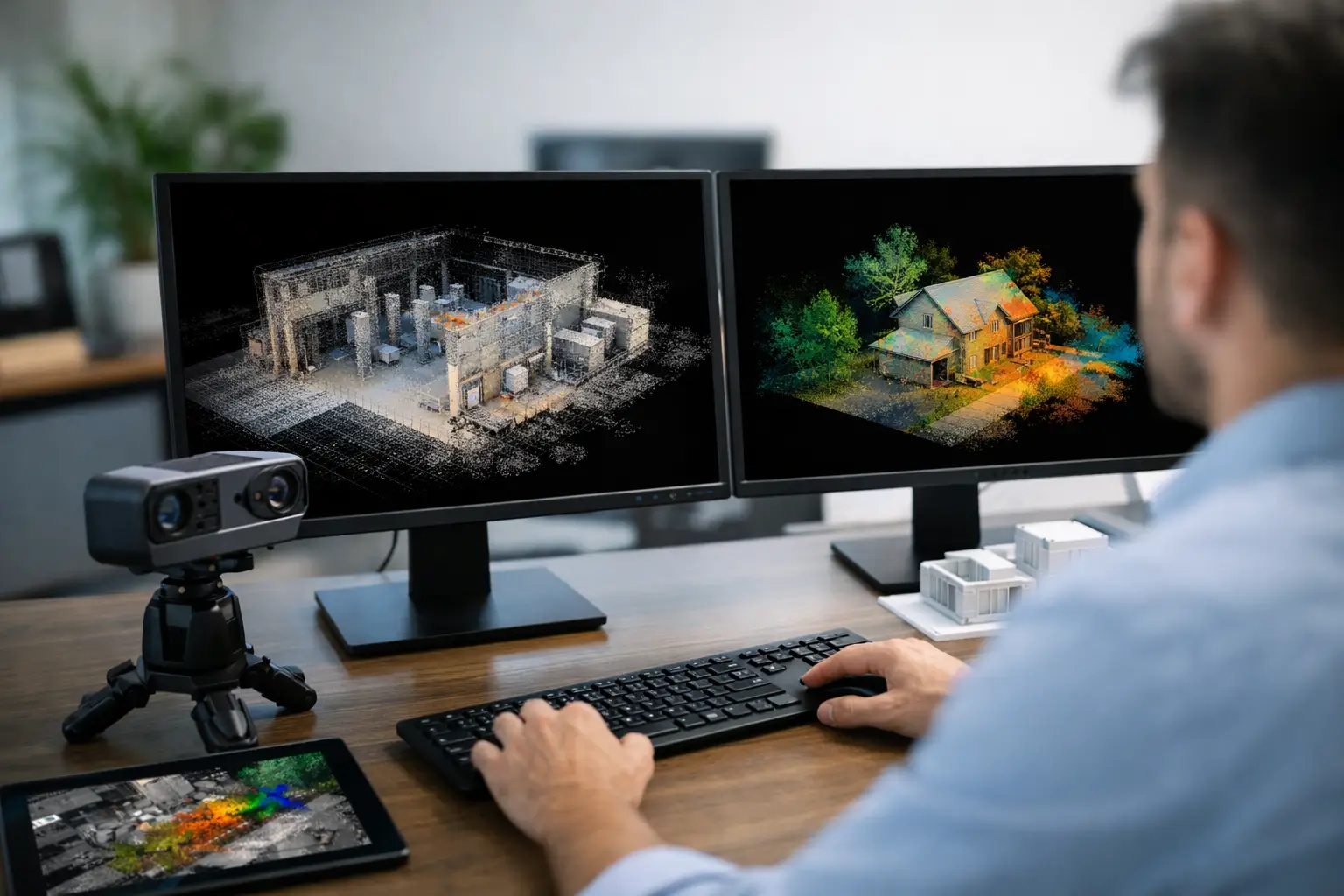
Raw scan data rarely causes the problem. The issue usually starts a few steps later, when millions or billions of points need to become something a design team, asset manager or contractor can actually use. That is where point cloud processing services matter. They turn field capture into dependable outputs – registered datasets, classified point clouds, 3D models, CAD drawings and analysis-ready deliverables that support real project decisions.
For many organisations, the pressure is not simply to capture more data. It is to reduce rework, shorten programme times and avoid errors caused by poor registration, inconsistent georeferencing or unusable file formats. Processing is the stage that determines whether a survey dataset becomes an operational asset or a costly archive.
What point cloud processing services actually cover
Point cloud processing services can range from basic scan registration to fully managed data production. The right scope depends on how the data was captured, what level of accuracy is required and what the final output needs to support.
At a practical level, processing often begins with data import, quality checks and registration. Individual scans or mobile mapping trajectories are aligned into a unified coordinate framework. If the project requires control integration, GNSS, RTK or total station references may be applied to place the dataset correctly within a survey grid or site coordinate system.
From there, the work usually moves into cleaning and refinement. Noise removal, artefact reduction and decimation may be needed, particularly on busy construction sites or in areas with vegetation, reflective surfaces or moving traffic. Classification can then separate ground, buildings, vegetation, structural elements or utilities depending on the application.
The final stage is output creation. That might mean a registered point cloud in a common exchange format, a measured BIM-ready model, 2D plans, elevation drawings, volume calculations or inspection deliverables. The processing stage is therefore not an isolated back-office task. It directly controls usability downstream.
Why processing quality matters more than many teams expect
A visually impressive point cloud is not necessarily a useful one. Datasets can look complete at first glance yet still contain alignment drift, control errors, duplicated surfaces or density issues that affect measurements and modelling. These problems become expensive when they are discovered late, especially after design work or construction decisions have already started.
This is why professional point cloud processing services are often a better fit than treating the task as a simple software exercise. Experienced processing teams understand the tolerances needed for different outputs. A façade inspection, a highway corridor survey and an internal MEP record all have different acceptance criteria. Processing must be matched to that end use.
There is also a commercial point. If a site team captures data quickly but the office spends days correcting preventable issues, the efficiency gain from modern LiDAR is reduced. Good processing protects the value of the original capture.
Point cloud processing services for different project types
Construction and civil engineering
On construction and infrastructure projects, processing usually needs to support layout verification, progress monitoring, as-built records and design coordination. Accuracy and coordinate integrity are critical because the outputs often feed directly into CAD, BIM or machine control workflows.
In these cases, registration and control checks are usually the priority. If the point cloud does not align properly with the project grid, every downstream decision is at risk. Processing may also include clipping by work area, surface generation, section extraction and comparison against design models.
Asset inspection and facilities
For building owners, utilities and infrastructure managers, the value often lies in accessibility. Processed point cloud data can support condition assessment, dimensional checks and planning for maintenance works without repeated site visits. Here, clarity and structure matter as much as raw density.
The dataset may need to be segmented by asset type or location so that engineering or maintenance teams can work with it efficiently. In some cases, full modelling is not necessary. In others, simplified asset models or measured drawings add more practical value than a large native point cloud alone.
Land surveying and topographic mapping
Survey-grade processing tends to focus on georeferencing, classification and extraction. Ground filtering, breakline support and terrain modelling are common requirements, particularly for topographic surveys, flood studies and route mapping.
The challenge is that automated classification is useful, but not infallible. Vegetation, embankments, overhead structures and mixed surfaces can all affect results. A dependable service combines software automation with experienced review, especially where contours, earthworks or drainage design depend on the output.
Heritage, forestry and complex environments
Historic buildings, woodland, quarries and industrial plants all create processing complications. Occlusion, irregular geometry and variable surface reflectivity can increase the amount of manual intervention needed. This is where service quality becomes visible very quickly.
A lower-cost processing route may be acceptable for visualisation. It is less suitable where conservation documentation, structural interpretation or inventory-grade measurement is required. The trade-off usually comes down to speed versus detail, and the right answer depends on the project brief rather than a one-size-fits-all workflow.
What to look for in a processing partner
The first question is not what software they use. It is whether they understand the final deliverable and the tolerance it must meet. A processing team should be clear about coordinate systems, control methodology, expected accuracy and required export formats before the work starts.
It also helps to assess whether the provider understands field capture as well as office processing. Teams with practical experience of terrestrial LiDAR, mobile mapping, drone surveys and GNSS workflows are generally better at diagnosing issues in the source data. They know the difference between a processing problem and a capture problem.
For many UK buyers, support and responsiveness are equally important. Survey and construction programmes move quickly. If a dataset needs urgent revision, additional clipping, a format conversion or model adjustment, the service provider must be able to respond without delay. That is often where a specialist geospatial partner adds more value than a generic data bureau.
Common outputs from point cloud processing services
The best output is the one that matches the next decision in your workflow. Some clients need a fully registered point cloud with no further interpretation. Others need extracted intelligence rather than raw data.
Typical deliverables include indexed point cloud files for use in standard viewing and modelling platforms, classified survey datasets, digital terrain models, orthographic imagery, measured elevations, floor plans, sections, clash-check support and 3D mesh or BIM-ready geometry. The right service should define these outputs at the outset rather than leaving them open to interpretation.
That clarity also helps with file management. Point cloud datasets can become very large, and not every end user needs full-resolution data. In some cases, splitting by area, level, asset class or project phase makes the deliverable far easier to use across design, engineering and commercial teams.
In-house processing or outsourced service?
There is no universal answer. Organisations with frequent capture programmes, trained staff and established software stacks may benefit from handling more processing internally. That gives direct control and may reduce long-term cost per project.
Even then, outsourcing can still make sense for peak workloads, specialist modelling or technically difficult datasets. Not every team wants to dedicate senior survey staff to intensive office processing when those people are needed on site.
For businesses that capture data occasionally, or that need reliable outputs without investing heavily in software licences and specialist training, outsourced point cloud processing services are often the more efficient option. The key is to compare the full cost, including staff time, QA, revision cycles and project risk, rather than software costs alone.
Getting better results from the start
Processing quality begins in the field. Good control, sensible scan planning, adequate overlap and consistent metadata reduce office time and improve final accuracy. The best service providers will say this plainly, even when they are handling the office work themselves.
That joined-up approach is where a specialist supplier can make a measurable difference. A business that understands hardware selection, survey methods, correction services, software and final outputs is in a stronger position to support the full workflow. For clients working across surveying, construction, asset management and inspection, that reduces fragmentation and improves accountability.
LiDAR Tech UK operates in exactly that space, supporting organisations that need not only the right capture equipment but also dependable data processing and deliverables that fit operational use.
When you are assessing point cloud processing services, the right question is not whether the provider can process the data. Most can. The better question is whether they can turn your dataset into a usable project asset, with the accuracy, structure and output format your team actually needs. That is where the value sits, and where good processing earns its place.