
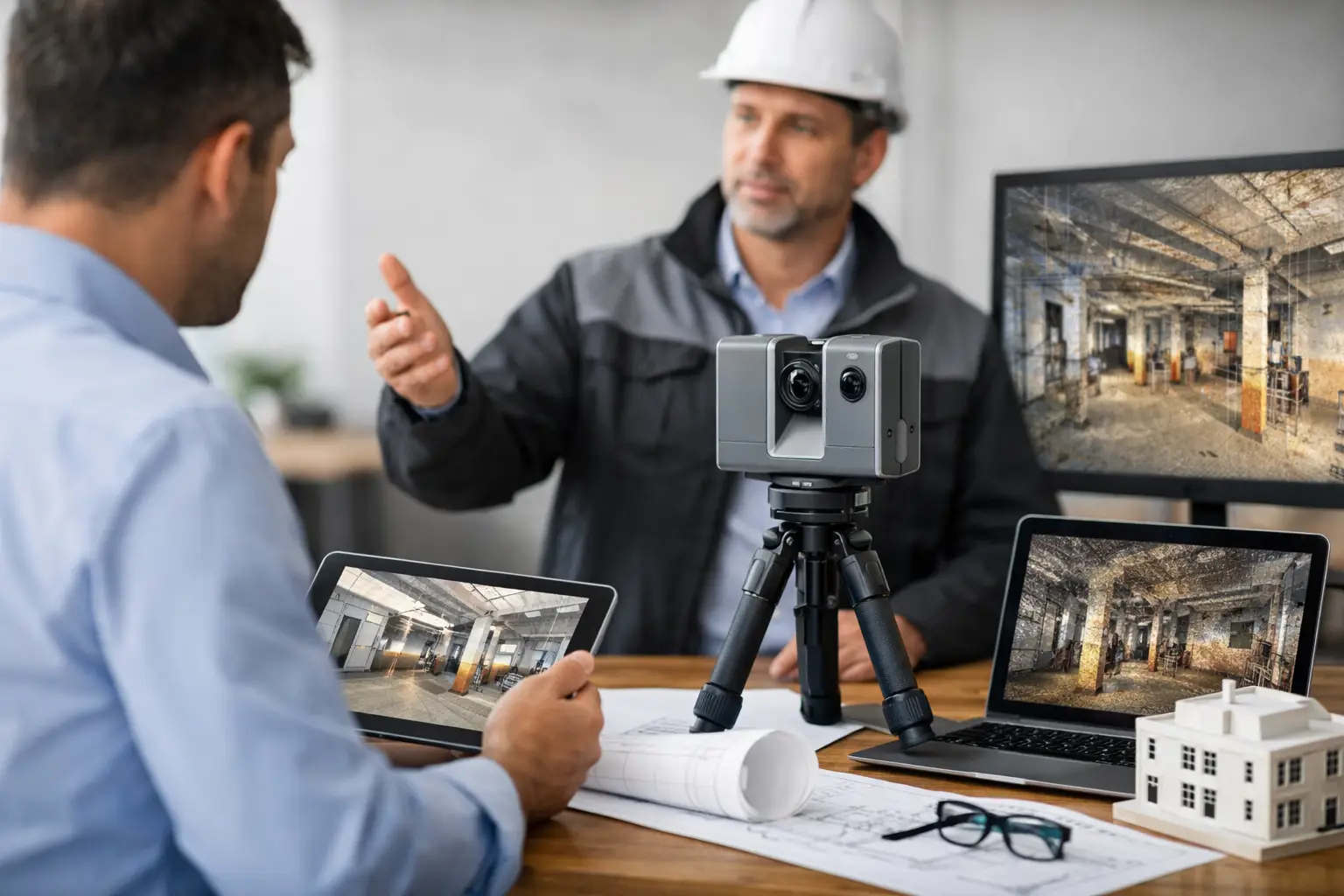
A model that looks polished in a coordination meeting is only useful if the underlying survey is right. That is why choosing a scan to BIM survey company is less about buying a 3D model and more about securing dependable geometry, clear scope control and data you can use across design, construction and asset management.
For contractors, consultants, estates teams and infrastructure owners, the problem is rarely whether laser scanning works. It does. The real question is whether the supplier can capture the right level of detail, control accuracy on site and deliver a BIM output that matches your software environment, information requirements and programme. That is where one provider can be very different from another.
What a scan to BIM survey company should actually deliver
At its core, scan to BIM is the process of capturing existing conditions using laser scanning, photogrammetry or a combined workflow, then converting that measured information into a structured digital model. In practice, the deliverable can vary significantly. One client may need an architectural Revit model for refurbishment design, while another needs a plant room model with service routes, clash-critical elements and asset data attached.
A capable scan to BIM survey company should start by defining the end use before a scanner is switched on. If the model is for planning and spatial coordination, the required granularity may be modest. If it is for prefabrication, retrofit or MEP redesign, tolerances and modelling rules become far stricter. When the purpose is unclear, projects often end up paying for detail that is never used, or worse, receiving a model too light to support design decisions.
This is why scope matters just as much as hardware. The best providers do not simply offer point cloud capture and modelling as separate boxes to tick. They align site control, survey method, registration, QA and object modelling to the decisions your team needs to make later.
How to assess technical capability
Not every survey company has the same field methodology, and not every BIM bureau understands survey risk. A strong provider needs both. Accurate scan to BIM work depends on control, coverage and validation, not just on owning modern equipment.
Survey control and accuracy
Ask how the company establishes control and verifies it. On a straightforward building survey, that may involve traverses, GNSS where appropriate and coordinated targets tied into an agreed datum. On constrained sites, internal control strategies matter more than headline scanner specifications.
Accuracy claims should also be specific. There is a difference between instrument accuracy, registration accuracy and final model accuracy. If a supplier cannot explain that distinction clearly, it becomes harder to trust the end result. For design teams, that matters because errors compound quickly once the model is referenced by structural, architectural and MEP disciplines.
Coverage and line of sight
Scan quality is shaped by what the instrument can actually see. Dense plant, reflective surfaces, confined risers and occupied environments all create gaps. A good provider plans around occlusions with station placement, supplementary capture and realistic assumptions about access.
This is one reason site experience matters. A scan to BIM survey company working regularly in live commercial buildings or infrastructure environments will usually be better at balancing productivity with completeness. Fast capture is valuable, but not if a return visit is needed because key interfaces were missed.
Modelling standards and software fit
You should also ask what software environment the provider works in and how the model will be structured. Revit is common, but the issue is not just file format. It is whether families, object naming, levels, grids and categorisation align with your standards.
For some projects, a geometry-rich model is enough. For others, COBie fields, asset tags or classification systems need to be built in from the start. If these requirements are added late, rework follows. The right supplier will test those requirements before mobilisation, not after delivery.
What to clarify before appointing a scan to BIM survey company
Procurement problems usually start with vague briefs. If you want reliable pricing and usable deliverables, define what success looks like in operational terms.
Begin with the survey extents. Is the requirement full building, selected floors, roofscape, façade, structural frame, MEP services or external setting out tie-in? Then define intended use. Refurbishment design, clash detection, record modelling and asset management all require different decisions on detail.
Level of information is another area where misunderstandings are common. Some clients ask for “BIM Level 2” when what they really need is a model to a project-specific level of graphical and non-graphical information. A competent provider will translate broad BIM language into measurable scope. That includes tolerances, exclusions and assumptions.
Programme is equally important. Rapid mobilisation is possible on many projects, especially where mobile scanning or drone capture can support access, but accelerated delivery only works when approvals, site permissions and output standards are already agreed. If deadlines are tight, ask how the company handles phased delivery so design teams can begin work before the full model package is complete.
Where technology makes the difference
The market is full of broad claims about faster capture and better digital workflows. Some are justified, some are sales language. What matters is whether the provider chooses the right capture method for the site.
Static terrestrial laser scanning remains the benchmark for high-detail building interiors, plant spaces and areas where controlled accuracy is critical. Mobile LiDAR can improve productivity across large or repetitive spaces, though it may not suit every tolerance requirement. Drone-based photogrammetry or aerial LiDAR is often valuable for roofs, façades, inaccessible elevations and external assets, especially where working at height would otherwise slow the job or introduce additional risk.
A technically capable survey partner knows when to combine these methods. That blended approach can reduce site time, improve coverage and produce more complete context for the final BIM model. It can also cut cost, but only when applied with discipline. More sensors do not automatically mean a better outcome.
For UK clients managing mixed estates, infrastructure corridors or complex industrial sites, it is often useful to work with a supplier that can handle both equipment deployment and outsourced project delivery. That means they understand the practical strengths and limitations of the technology rather than treating it as a black box. LiDAR Tech UK sits in that category, combining hardware expertise with field services and data deliverables.
Commercial questions worth asking
Price still matters, but cheapest is rarely cheapest once omissions, return visits or remodelling are factored in. When comparing quotations, look closely at what has and has not been included.
Point cloud registration, survey control, model authoring, QA checks, clash-ready geometry, file export formats and revision rounds should all be clear. If a fee looks unexpectedly low, it may exclude items that your team assumed were standard.
Insurance, health and safety competence and experience in live environments should also be part of the assessment. For occupied buildings, hospitals, rail-adjacent sites, utilities assets and public-sector estates, logistics and compliance can shape project performance as much as technical ability.
It is also reasonable to ask who will do the work. Some firms outsource modelling entirely after capture. That is not always a problem, but it can create disconnects between field reality and model interpretation. A tighter survey-to-model workflow usually leads to fewer assumptions and cleaner issue resolution.
When scan to BIM is the right choice – and when it is not
Scan to BIM is highly effective where existing conditions are complex, documentation is outdated or site access is limited. Refurbishment, retrofit, heritage work, plant replacement and façade projects are all strong use cases because precise geometry reduces design uncertainty.
It is less compelling where the required output is simply a measured 2D plan with minimal future coordination needs. In those cases, a full model may add cost without adding much value. The right provider should say that plainly. Good advice is not always the most expensive option.
There are also cases where a point cloud plus selective modelling is the smarter commercial choice. If only structure and major services affect the next design stage, modelling every minor object may be unnecessary. This is where experienced suppliers stand out – they match the deliverable to the decision, not to a generic workflow.
A dependable scan to BIM survey company should leave you with more than a model. It should give your team confidence that what is on screen reflects what is on site, and that confidence is what keeps design moving, variation risk down and project decisions grounded in measured fact.