
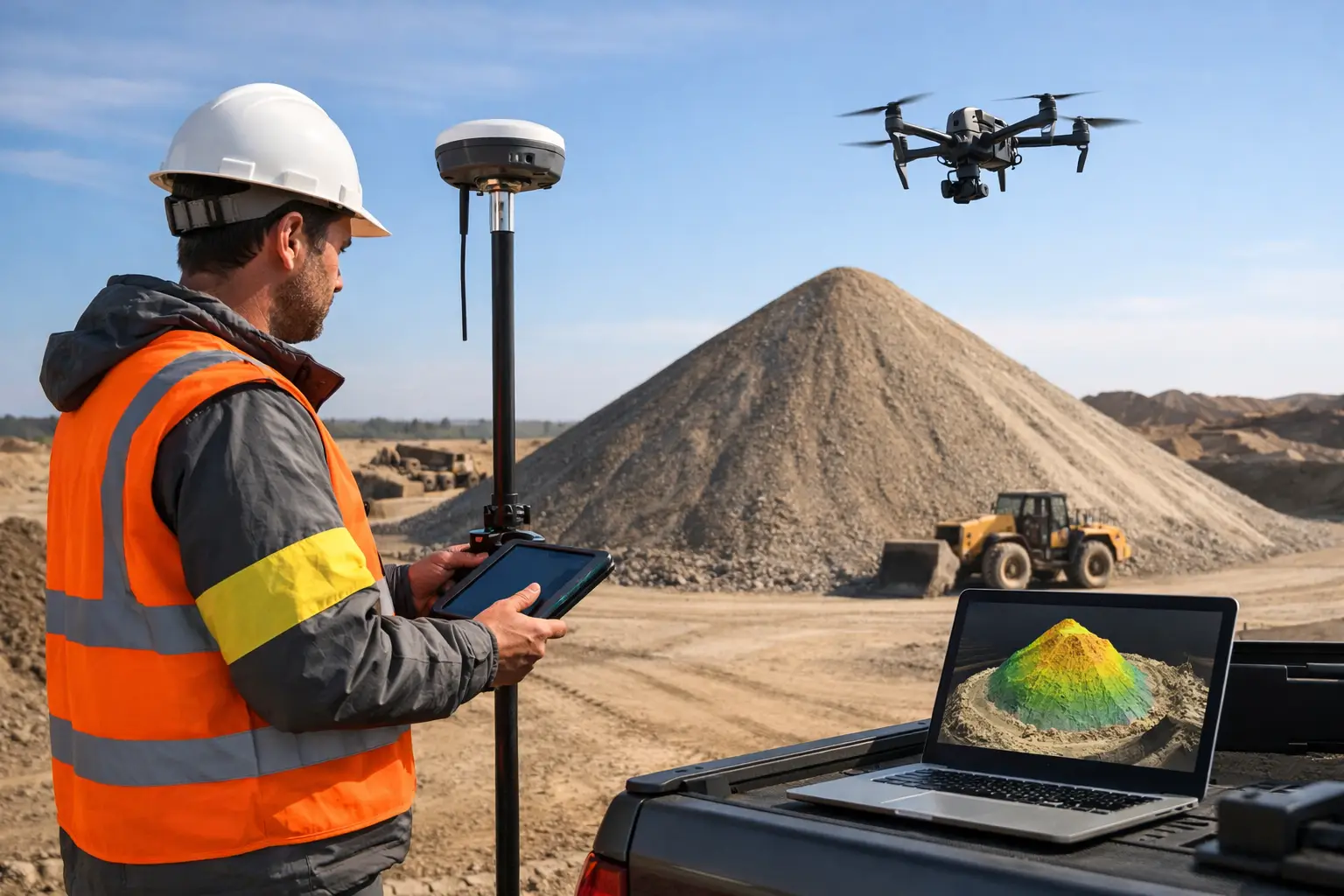
When stock figures on paper do not match what is on the ground, the cost shows up quickly – in procurement errors, billing disputes, production planning gaps, and avoidable site risk. Volumetric stockpile survey services give operators a reliable way to measure material volumes with far greater speed and consistency than manual methods, especially across large, active, or difficult-to-access sites.
For quarries, recycling facilities, construction compounds, ports, and bulk material handlers, stockpile measurement is not just an occasional reporting task. It affects commercial control, operational planning, and compliance. The question is less whether to measure, and more how to do it accurately, safely, and often enough to support decisions that matter.
What volumetric stockpile survey services actually provide
At a practical level, volumetric stockpile survey services capture the shape of a stockpile or a group of stockpiles, process that survey data into a surface model, and calculate material volumes against a defined base. The end result is a measurable quantity that can be used for inventory reporting, contractor payment, progress tracking, or internal reconciliation.
The service itself can vary depending on the site and the level of detail required. Some projects involve a straightforward monthly stock count across a quarry or depot. Others require high-frequency surveys for earthworks progress, staged excavation monitoring, or material movement analysis across multiple zones.
What matters most is not just collecting data, but collecting the right data in the right way. A volume figure is only useful if the survey control, capture method, processing workflow, and base definition are all suitable for the site conditions and reporting purpose.
Why traditional stockpile measurement often falls short
Many sites still rely on methods that are workable in theory but inconsistent in practice. Manual GPS shots, tape-based checks, machine estimates, and visual approximation can all introduce unnecessary variation. On simple piles these methods may appear adequate, but once stockpiles become irregular, steep, numerous, or frequently changing, confidence in the figures drops.
There is also the issue of access. Sending personnel onto unstable or recently worked material carries obvious safety concerns. Even where access is possible, collecting enough points to model a stockpile properly can take considerable time, particularly on busy industrial sites where plant movements and operational constraints limit survey windows.
That is why modern survey workflows increasingly use drone photogrammetry, LiDAR scanning, and GNSS-supported control. These methods reduce time on the pile, improve coverage, and produce a denser dataset for more dependable volume calculations.
How modern stockpile surveys are carried out
Most current stockpile surveys begin with a review of the site, the material types, required outputs, and the level of accuracy needed. A quarry manager looking for monthly inventory totals may need a different level of detail from a contractor measuring cut and fill against a design surface.
Ground control is usually established or verified first. This is a critical step because volume outputs are only as reliable as the positional framework behind them. Depending on the environment, this may involve GNSS, RTK correction workflows, or total station control.
The data capture stage then follows. For broad site coverage, enterprise drones are often the most efficient option. They can survey multiple stockpiles quickly, minimise disruption to operations, and provide dense image data suitable for photogrammetric modelling. Where vegetation, complex geometry, poor texture, or difficult lighting are factors, LiDAR may be the better fit. On some sites, a combined approach delivers the best result.
Once captured, the survey data is processed into a terrain or surface model. Stockpile boundaries are checked, voids or noise are corrected, and volumes are calculated against an agreed base surface. Deliverables can include volume tables, orthomosaic mapping, contour plans, point clouds, CAD-ready files, and repeat-survey comparisons.
Volumetric stockpile survey services and accuracy
Accuracy is the point most buyers focus on, and rightly so. However, there is no single accuracy figure that applies to every project. The right standard depends on the survey method, control quality, material surface, environmental conditions, and how the result will be used commercially.
For example, loose aggregate with a clearly defined surface is generally more straightforward to model than dark, reflective, or heavily disturbed material. Similarly, a well-controlled drone survey on an open site may produce excellent results, but if the base of the stockpile is poorly defined, the final volume can still be open to question.
This is where an experienced provider adds value. Good volumetric stockpile survey services are not simply about flying a drone or scanning a pile. They are about selecting a method that fits the job, applying proper survey control, and explaining tolerances honestly. In commercial terms, a fast answer is not enough if the method cannot stand up to scrutiny.
Where these services deliver the strongest return
The commercial case is usually strongest where material volumes change regularly, where stock levels affect working capital, or where disputes over measured quantities have direct financial consequences. Quarries and aggregate businesses are obvious examples, but they are not the only ones.
Construction and civil engineering projects use stockpile surveys to track imported fill, excavated spoil, and progress against programme. Waste and recycling operators use them to support reporting, capacity planning, and material throughput analysis. Ports and logistics sites use them to monitor bulk commodities where volume visibility supports both operational planning and customer reporting.
There is also a strong case in environments where health and safety considerations limit conventional access. Surveying from the air or from a safe standoff position can reduce exposure to unstable slopes, moving machinery, and active loading zones.
Choosing the right survey method for the site
No single capture method is best in every case. Drone photogrammetry is efficient, cost-effective, and well suited to large open sites with clear visibility. It is often the preferred option for routine stockpile reporting because it balances speed and detail well.
LiDAR comes into its own where surface texture is inconsistent, where complex structures sit close to the stockpiles, or where a dense and direct 3D measurement is required. Terrestrial or mobile LiDAR can also be useful in confined areas, under cover, or where flight restrictions apply.
GNSS-based ground survey still has a role, particularly for control establishment, validation, or small isolated tasks. It is not obsolete. It is simply less efficient as the primary measurement method when sites are large or stockpile geometry is complex.
The right provider should be comfortable advising on that trade-off rather than forcing every project into one workflow. That is especially relevant for UK operators dealing with mixed sites, variable weather, and live operational constraints.
What to look for in a service provider
The quality of the deliverable matters just as much as the survey itself. Professional buyers should look for a provider that can explain methodology clearly, define expected outputs in advance, and work within the practical realities of an operational site.
That includes understanding access rules, RAMS requirements, flight permissions where needed, control strategy, and output formats that fit downstream workflows. If the result has to support CAD teams, commercial managers, or site engineers, the data should arrive ready to use rather than requiring further interpretation.
It is also worth asking how repeatability is handled. If surveys are being carried out monthly or quarterly, consistency in method is essential. Trend reporting only works when capture and processing are controlled properly from one survey to the next.
For organisations that also procure hardware, software, and support, working with a geospatial specialist that understands both service delivery and the underlying technology can simplify implementation. LiDAR Tech UK supports that broader model by combining data capture capability with practical expertise in LiDAR, GNSS, RTK, and enterprise drone workflows.
The value is in better decisions, not just better measurements
Volume data becomes useful when it feeds action. That might mean ordering the right amount of aggregate, validating subcontractor claims, planning extraction phases, or reconciling inventory with finance records. The more regularly and reliably a site can measure stock, the fewer assumptions operators have to make.
There is, of course, a balance to strike. Higher survey frequency brings better visibility, but only if the reporting cycle matches operational need. Some businesses need weekly updates. Others only need month-end figures with strong confidence levels. The best approach depends on how quickly stock moves, how material is billed, and how much uncertainty the business can tolerate.
If your site depends on accurate material quantities, volumetric stockpile survey services are not a nice-to-have. They are a practical control measure that supports safer operations, cleaner reporting, and more confident commercial decisions.