
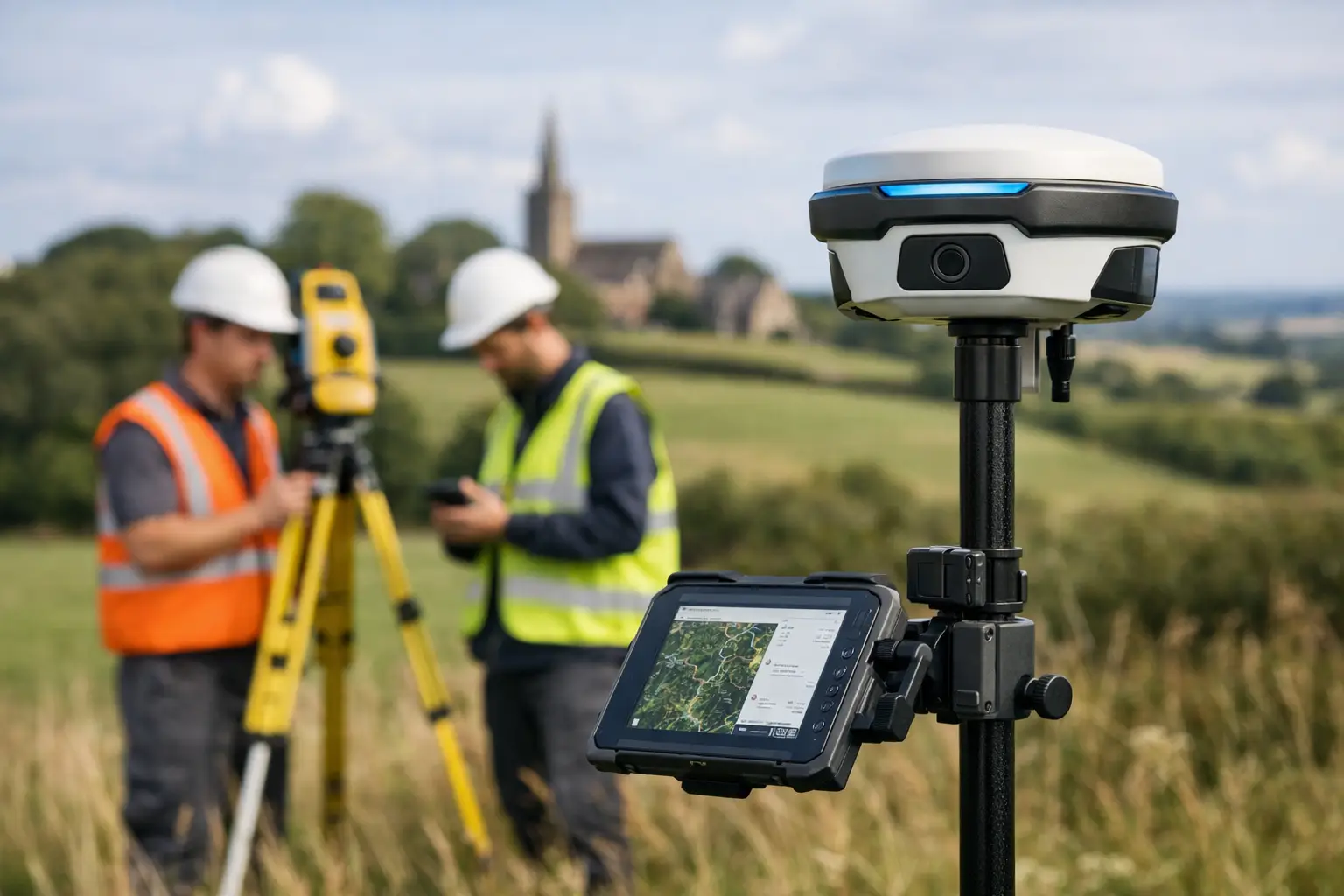
When a mobile scanner is being considered for live project work, the question is rarely whether it can capture data. The real test in any FJD Trion S1 review is whether it can produce reliable, usable outputs fast enough to justify its place in a professional survey workflow. For UK surveyors, contractors and asset teams, that means looking beyond headline specifications and judging how the system performs on site, in processing, and under commercial pressure.
FJD Trion S1 review: where it fits
The FJD Trion S1 is positioned as a handheld and backpack-capable SLAM LiDAR system for rapid reality capture. Its appeal is straightforward. It gives teams a way to survey complex spaces far more quickly than a static terrestrial laser scanner, while avoiding some of the line-of-sight and setup constraints that slow conventional methods.
That makes it particularly relevant for building interiors, plant rooms, facades, heritage spaces, construction progress capture, stockpile environments and sites where access is awkward or time on site is limited. If your work depends on millimetre-level control over small, high-detail features, a static scanner will still have the advantage. If your priority is efficient area coverage and practical deliverables, the Trion S1 becomes much more compelling.
This is an important distinction. The S1 is not a replacement for every survey instrument. It is a productivity tool that suits specific workflows very well.
What stands out in day-to-day use
The strongest argument for the Trion S1 is speed. A competent operator can move through indoor and mixed environments quickly, gathering a large amount of spatial data in a single pass. That has obvious value for contractors documenting existing conditions before works begin, facilities teams recording service voids, or survey practices handling high volumes of as-built capture.
The mobility of the platform also matters. In real jobs, speed only helps if the system is practical to carry, simple to deploy and forgiving enough for repeatable use across different operators. The S1 performs well here because it lowers some of the operational barriers often associated with laser scanning. There is less dependence on multiple static setups, fewer interruptions to reposition equipment and less friction when moving between rooms, levels or confined areas.
For organisations trying to expand 3D capture without committing every project to a specialist scanning crew, that usability has commercial value. Training requirements still exist, but the path to productive deployment is generally shorter than with more traditional terrestrial systems.
Accuracy and data quality
Any serious FJD Trion S1 review has to address accuracy with some care, because this is where expectations need to be managed properly. SLAM-based LiDAR can be very effective, but it is not magic. Data quality depends on the environment, the route taken by the operator, the availability of distinctive geometry, the quality of loop closure and the discipline of the capture method.
In suitable environments, the Trion S1 can generate point clouds that are more than adequate for many measured building, asset documentation and design support applications. For general floorplans, elevation work, volumetric understanding, space planning, BIM context modelling and condition recording, the output can be highly useful and cost-effective.
Where teams need very tight tolerances, formal control integration or survey deliverables that will be scrutinised against higher-precision standards, the discussion changes. In those cases, survey control, check data and workflow validation become essential. The S1 can sit within a broader survey methodology, but it should not be treated as a shortcut around quality assurance.
That is not a weakness unique to this unit. It is simply the reality of mobile SLAM scanning. Buyers who understand that tend to get strong results from systems like this, while buyers expecting static-scanner precision at walking pace are more likely to be disappointed.
Processing workflow and outputs
Field capture is only half the equation. Professional buyers need to know whether the scanner fits into existing deliverable pipelines. Here, the Trion S1 makes sense for teams that want to move efficiently from site capture to point cloud review, modelling and CAD or BIM production.
The practical benefit is that the system supports a faster capture-to-output process for many common commercial tasks. If your business is regularly documenting interiors, service areas, industrial spaces or existing structures before refurbishment, the time saved in the field can be significant. For some jobs, the reduction in site labour and access disruption is more valuable than chasing the last few millimetres of precision.
That said, processing discipline still matters. Mobile scans need review, registration checks where relevant, and a clear understanding of what the final deliverable requires. A fast capture workflow is only commercially useful if the resulting point cloud is clean enough for the downstream team to work efficiently.
Strengths for UK professional users
The Trion S1 is particularly attractive where projects involve constrained access, variable site conditions or a need for repeated surveys over time. Construction firms can use it for progress records and coordination checks. Surveyors can use it to cover large interiors and complex circulation areas quickly. Asset owners can use it to digitise buildings and plant spaces without major operational disruption.
There is also a strong case for organisations that are building in-house capture capability. A system like this can help bridge the gap between occasional outsourced scanning and a full static-scanner-led survey department. For many businesses, that is a sensible commercial step because it allows more frequent data capture without creating excessive operational overhead.
In the UK market, support and implementation are just as important as the hardware itself. Buyers should look closely at training, setup guidance, software workflow support and the availability of local technical help. A capable scanner without practical deployment support can still become an underused asset.
Limits and trade-offs
The main trade-off is precision versus productivity. That sounds obvious, but it affects procurement decisions more than any single feature on a datasheet. If your core business depends on high-accuracy control surveys, deformation monitoring or detailed heritage recording at the tightest tolerances, the S1 is unlikely to be your only scanning solution.
Environmental conditions also matter. Feature-poor corridors, reflective surfaces, cluttered plant spaces and inconsistent movement patterns can all affect SLAM performance. Skilled capture technique reduces the risk, but it does not remove it entirely. Buyers should assess the scanner against their actual project environments rather than ideal demonstrations.
There is also the question of internal capability. Rapid capture systems can create the impression that scanning is now simple enough for anyone to operate without much thought. In practice, successful use still depends on survey planning, route logic, quality checks and an understanding of how point cloud data will be used afterwards.
FJD Trion S1 review: best-fit applications
The S1 makes the most sense where speed, coverage and practical access are the leading priorities. Measured building context surveys, interior as-builts, MEP space capture, refurbishment planning, construction verification, estate documentation and digital twin groundwork are all sensible use cases.
It is also well suited to service providers who need to increase scan volume without scaling site time at the same rate. That can improve margins on repeatable projects, especially where clients care more about timely, reliable digital records than ultra-high-detail geometric capture.
By contrast, teams focused on formal topographic outputs over large external areas may still prefer workflows built around GNSS, total stations, UAV photogrammetry or higher-end mobile mapping systems, depending on specification. Likewise, specialist heritage and forensic applications may call for different tools or a hybrid method.
Should you buy the FJD Trion S1?
For the right buyer, yes. The FJD Trion S1 is a credible professional tool for organisations that need faster 3D capture of buildings, assets and complex interiors, and that understand the operational strengths of SLAM LiDAR. It offers clear efficiency gains, practical mobility and useful output quality for a broad range of commercial survey tasks.
It is not a universal answer, and it should not be bought on the assumption that it replaces every other survey instrument. The strongest purchasing case exists where teams have a defined need for rapid reality capture, a realistic view of accuracy requirements and a plan for how point cloud data will be processed into client-ready deliverables.
For UK businesses evaluating deployment, the most sensible next step is not simply comparing brochure specifications. It is testing the scanner against a live workflow, a known site type and an actual deliverable requirement. That is usually where the real value becomes clear.
If the Trion S1 aligns with your survey tolerance, site conditions and turnaround expectations, it can be a very effective addition to a modern geospatial toolkit. The best results come when the technology is chosen for the job it is genuinely designed to do, then backed by proper training, support and a workflow that turns fast capture into dependable output.