
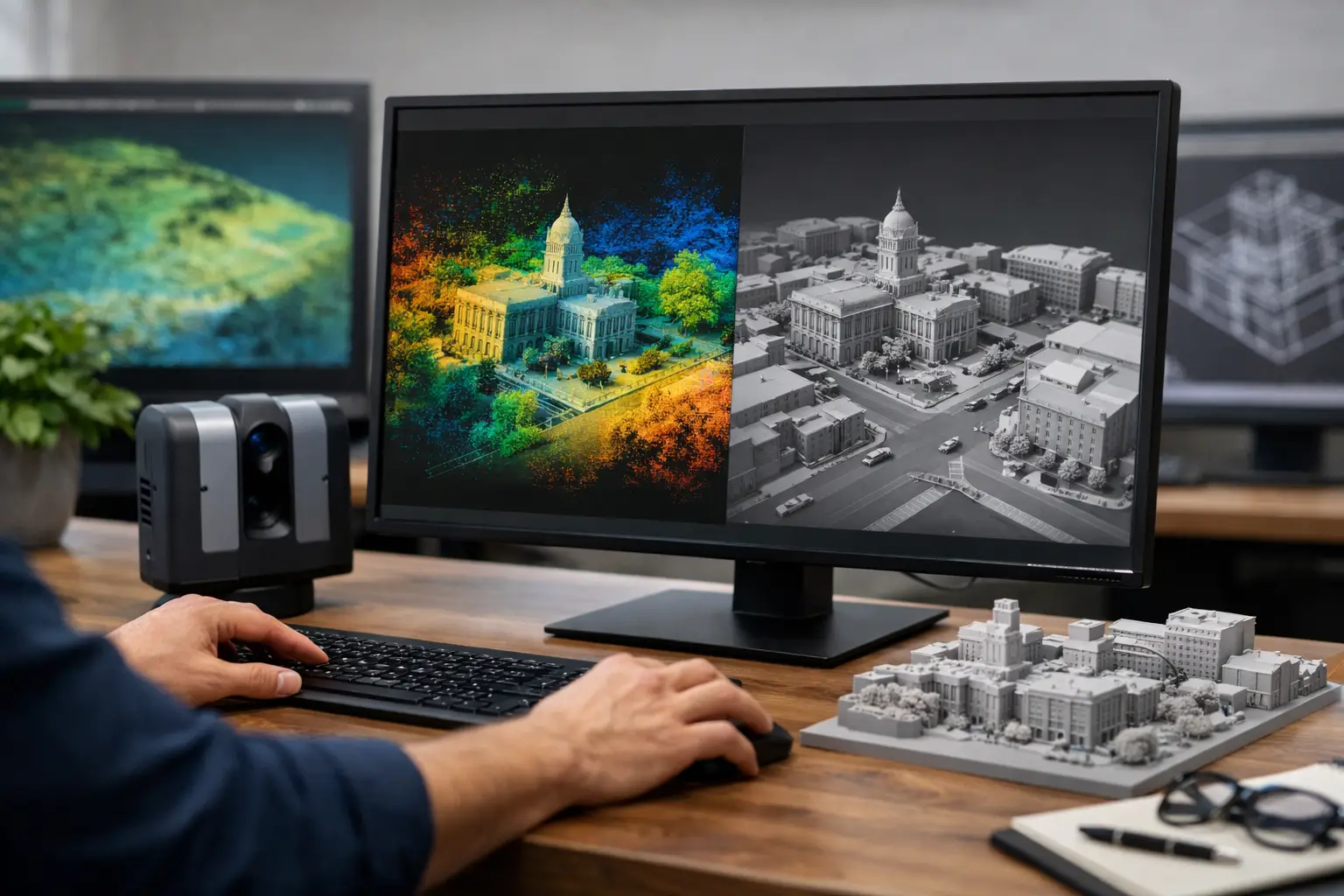
A missed detail in a plant room, a façade that is a few centimetres out, or an incomplete terrain surface can create expensive problems later in design and delivery. That is why 3D modelling from LiDAR data has become a practical requirement for many surveying, construction and infrastructure teams, not simply a specialist visualisation exercise. When the model needs to reflect real site conditions, LiDAR provides a level of speed, coverage and geometric confidence that traditional methods often struggle to match on their own.
For professional buyers, the key question is not whether LiDAR can produce a 3D model. It can. The more useful question is what kind of model is needed, how accurate it must be, and what workflow will produce a result that is fit for design, coordination, inspection or asset management. The value sits in the output, not just the scan.
What 3D modelling from LiDAR data actually means
In practical terms, 3D modelling from LiDAR data starts with a point cloud. A terrestrial scanner, mobile mapping system or drone-mounted LiDAR sensor captures millions of measured points across a site, structure or asset. Those points represent real geometry in three-dimensional space and can then be registered, cleaned, classified and converted into usable deliverables.
That deliverable may be a mesh for visual context, a CAD model for design work, a BIM-ready representation of a building, a terrain model for planning, or a measured asset model for maintenance and inspection. The right format depends on the project brief. A highways team assessing corridor geometry will need something different from a heritage consultant recording a listed structure or a contractor checking as-built steelwork.
This is where projects often succeed or fail. If the capture method, control strategy and modelling standard are not aligned from the outset, even a high-density point cloud can produce a poor commercial outcome. More data does not automatically mean a better model.
Why 3D modelling from LiDAR data is now a mainstream workflow
The adoption curve has shifted because project teams are under pressure to reduce time on site, improve safety and cut rework. LiDAR supports all three. It captures complex environments quickly, reduces the need for repeated site visits, and gives office teams a dense spatial record to interrogate after the fieldwork is complete.
For construction and civil engineering, that means faster existing-condition surveys, better clash awareness and more reliable quantities. For utilities and infrastructure owners, it supports asset documentation without prolonged access restrictions. For forestry, land and environmental work, it improves terrain and canopy understanding across larger areas than manual methods can cover efficiently.
There is also a commercial point here. A well-executed LiDAR workflow can shorten programme time and reduce downstream design uncertainty. However, there is always a balance between speed, accuracy and deliverable complexity. A drone survey may cover a large site faster than terrestrial scanning, but it may not provide the same detail in occluded areas or beneath canopy. A handheld or mobile system may be excellent for internal capture speed, but fixed scanning and tighter control can still be the better choice where tolerance is critical.
Choosing the right capture method
Not every job requires the same sensor platform. The model specification should drive the capture approach, not the other way round.
Terrestrial LiDAR for high-detail measured environments
Static terrestrial scanning remains one of the strongest options where detail, control and repeatability matter most. It is well suited to buildings, façades, industrial plant, structural surveys and heritage recording. The main advantage is precision in complex spaces, especially where line-of-sight planning is possible and site access can be managed properly.
The trade-off is field time. Static setups take longer than mobile methods, and registration quality depends on disciplined survey control and good scan planning.
Mobile and SLAM-based LiDAR for speed indoors and on complex routes
Mobile mapping and SLAM-based systems are useful where speed is the priority, particularly across warehouses, commercial interiors, tunnels, corridors and operational facilities. They can reduce capture time significantly and allow teams to move through the site with less disruption.
That said, the workflow depends heavily on the quality of the trajectory solution and the environment itself. Repetitive spaces, weak loop closure and limited control can affect consistency. These systems are highly effective when used in the right context, but they are not a universal replacement for survey-grade static methods.
Drone LiDAR for terrain, roofs and inaccessible assets
Drone-mounted LiDAR is particularly effective for topographic modelling, stockpiles, corridors, embankments, utilities routes, roofs and other areas where ground access is inefficient or unsafe. It also offers clear benefits where vegetation penetration is needed for terrain extraction.
The limits are equally clear. Airborne data is excellent for area coverage, but not always the best choice for detailed building interiors, fine façade features or small MEP elements. In many projects, the strongest result comes from combining drone LiDAR with terrestrial scanning or photogrammetry rather than relying on a single source.
From point cloud to usable model
Capturing the data is only one part of the job. The real discipline in 3D modelling lies in processing and interpretation.
Registration and geo-referencing come first. If the point cloud is not correctly aligned to control, every downstream deliverable is compromised. Cleaning follows, removing noise, irrelevant objects and moving artefacts where necessary. Classification may then separate ground, vegetation, buildings and assets, depending on the required output.
After that, the workflow diverges according to the brief. Terrain modelling may involve breaklines, surface generation and feature extraction. Building modelling may require walls, floors, roofs, openings and structural elements to be interpreted from the point cloud into CAD or BIM geometry. Asset workflows may focus on pipe runs, cable trays, equipment locations or clearance envelopes.
This stage is where assumptions need to be managed carefully. LiDAR captures what it can see. It does not infer hidden services inside walls or behind cladding. If the model needs non-visible features, existing records or additional intrusive survey work may still be required. Good modelling practice is about transparency as much as accuracy.
What affects quality and accuracy
There is no single figure that defines whether a LiDAR model is good enough. Accuracy depends on sensor capability, control quality, scan density, environmental conditions, operator method and the tolerance required by the end use.
A planning model for visual context can accept a different level of detail from a fabrication check or deformation analysis. Likewise, a broad earthworks surface does not require the same point density as a mechanical plant model. This is why the most reliable projects begin with a clear specification covering coordinate system, expected tolerances, level of detail, deliverable format and intended use.
Environmental conditions matter as well. Reflective surfaces, rain, dense vegetation, poor GNSS availability and heavy traffic can all affect capture quality. None of these issues make LiDAR unsuitable, but they do affect how the survey should be designed and what supporting methods may be needed.
Where the commercial value is strongest
The strongest return on 3D modelling from LiDAR data usually appears where site complexity, access constraints or rework risk are high. Industrial facilities are a good example. A precise existing-condition model can support retrofit design, shutdown planning and prefabrication with fewer surprises on site.
In construction, it can help teams validate as-built conditions before new works begin. In infrastructure, it supports inspection and asset records without relying on incomplete legacy drawings. In land and environmental applications, it can produce terrain and surface information at a scale that manual survey alone would struggle to achieve efficiently.
There is also a procurement benefit in choosing a supplier that understands both the hardware and the downstream workflow. Organisations do not only need a scanner or a drone. They need a dependable route from capture through to a model that their design, engineering or asset teams can actually use. That is where a specialist provider such as LiDAR Tech UK can add value, combining equipment knowledge with practical delivery and support.
When LiDAR is not the whole answer
A realistic approach matters. LiDAR is highly effective, but it is not always the complete survey solution on its own. Projects may still need total station control, GNSS positioning, photogrammetry, conventional measured survey or manual verification of critical features.
That is not a weakness. It is how professional workflows should operate. The aim is not to force every site into one method. The aim is to select the right combination of technologies for the required output, budget and programme.
For buyers evaluating 3D modelling capability, the best question to ask is simple: what decision will this model support? Once that is clear, the right capture method, processing standard and deliverable become much easier to define. The most useful model is the one that reduces uncertainty, supports action and stands up to scrutiny when the project moves from survey into design and delivery.